
Amman in a day or two: what's actually worth your time
Most visitors treat Amman as an airport with a hotel attached — land, sleep, and bolt for Petra at dawn. That's a mistake. Jordan's capital is a city of nineteen hills where a 2,000-year-old Roman theatre sits below a citadel that has been occupied since the Bronze Age, and where the real pleasure is small: a glass of tea on a stepped alley, falafel eaten standing up, the call to prayer bouncing between the hills at dusk. Give it a day and it will surprise you. Give it two and you'll wish you'd booked longer.
Heads up: some links on this page are affiliate links. If you book through one we may earn a small commission at no extra cost to you — it keeps these guides free. It never changes what we recommend.
Get your bearings: the city of hills
Amman is built on hills — jabals — and the city grew up around them, each once its own village. You don't need all of them, only four:
- Downtown (al-Balad) — the old heart, in the valley: the Roman Theatre, the Husseini Mosque, the gold and spice souks, and the best cheap food in the country.
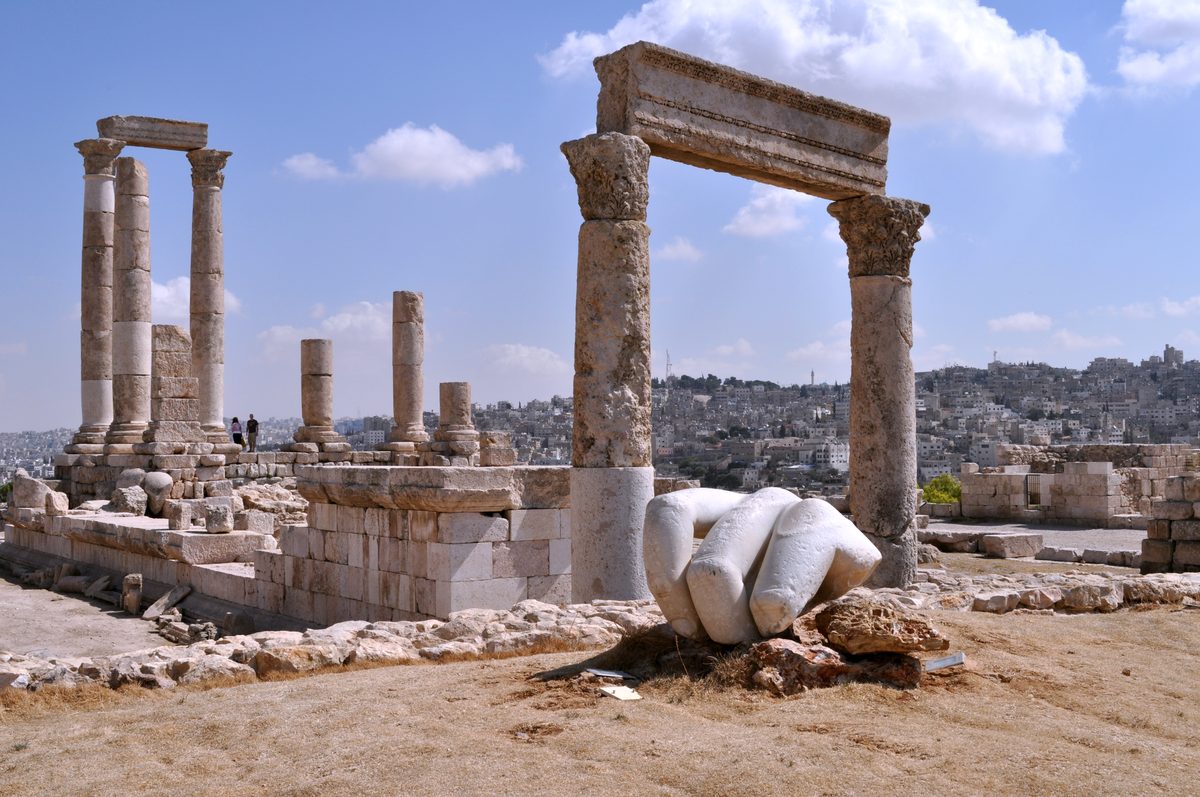
- Jabal al-Qal'a (the Citadel) — the hill directly above downtown, crowned by the Temple of Hercules and the Umayyad Palace, with the city's best view.
- Jabal Amman — the genteel hill of Rainbow Street, embassies, and old stone villas turned into cafés.
- Jabal al-Weibdeh — the arts quarter: galleries, bookshops, tree-lined steps and the city's best coffee culture.
Everything below happens within these four. Between them it's a five-minute taxi hop; within each, you walk.
One perfect day in Amman
Morning — the Citadel (Jabal al-Qal'a). Start high. The Citadel is an open archaeological site on the hilltop, holding the columns of the Temple of Hercules, the domed Umayyad Palace, and a small but excellent Jordan Archaeological Museum. Go in the morning before the heat and the coach tours. The reason to come first isn't only the ruins — it's the view. From the edge you see the whole amphitheatre of the city spilling white across the hills, and you finally understand its shape.
Late morning — the Roman Theatre and downtown. Walk or take a short taxi down to al-Balad. The Roman Theatre, cut into the hillside in the 2nd century for six thousand spectators, still does. Climb to the top row for the view back up to the Citadel. Then wander: the Husseini Mosque, the gold souk, the spice and nut stalls, the fruit-juice carts. Downtown Amman is loud, warm and completely unpretentious — this is the city being itself.
Lunch — eat where the queue is. Downtown is the home of two Amman institutions (more on both below). Eat cheaply and well, then keep walking.
Afternoon — Rainbow Street (Jabal Amman). A taxi up to Rainbow Street drops you into the other Amman: old villas, boutiques, and the terraces where the city drinks its coffee. Duck into the side streets to find the "Souk Jara" weekend market (summer Fridays) and the viewpoints over the valley.
Sunset — anywhere with a terrace. Amman is a sunset city. Find a rooftop on Rainbow Street or in Weibdeh, order mint lemonade or mezze, and watch the hills turn gold and then pink while the evening call to prayer rolls across them. This is the moment people remember.
A second day: art, coffee and day trips
One day is the highlights; the second day is where you actually like Amman.
Spend the morning in Weibdeh. Jabal al-Weibdeh is the city's creative quarter — small galleries (Darat al Funun, with its terraced gardens and Byzantine ruins, is free and lovely), independent bookshops, and cafés on stepped lanes. It's the most walkable, most relaxed corner of the city, and the best place to feel Amman's modern personality rather than its ancient one.
Then use Amman as a base. The city is the natural launch pad for three of Jordan's best day trips, all within 90 minutes:
- Jerash — one of the best-preserved Roman provincial cities anywhere, 50 minutes north.
- The Dead Sea — float in the lowest water on Earth; see our Dead Sea day trip guide.
- The desert castles — a loop of Umayyad hunting lodges and caravanserais east of the city, including the frescoed Qusayr Amra (a UNESCO site).
If your whole trip is short, this is how Amman earns its keep: a comfortable city to sleep in, with the north and the Dead Sea an easy morning away.
What to eat
Amman eats brilliantly and cheaply. Three things you shouldn't leave without:
- Falafel and hummus for breakfast, downtown. A plate of hot falafel, hummus with a pool of olive oil, fresh bread and sweet tea is the classic Amman morning — and it costs a couple of dinars.
- Knafeh. The national sweet weakness: molten cheese under crisp orange semolina, soaked in syrup, served hot by weight from a downtown counter. Eat it standing up, immediately.
- Mezze and mansaf. A proper sit-down meal in Amman means a table of small dishes — hummus, mutabbal, tabbouleh, fattoush, grilled meats — and, at least once, mansaf, Jordan's national dish of lamb, jameed yoghurt and rice.
We're writing a full Jordanian food guide next — for now, the rule is simple: eat where locals queue, and say yes to anything offered with tea.
Getting around and practical basics
Taxis and Careem. Yellow taxis are everywhere and cheap; insist on the meter, or use the Careem app (the regional equivalent of Uber) to avoid haggling. Between neighbourhoods, a ride is usually only a dinar or two.
Walking. Amman's hills are real — downtown to the Citadel is a steep climb, and the famous stepped streets are lovely but tiring. Wear proper shoes and don't try to walk between distant hills.
From the airport. Queen Alia International (QAIA) is about 35 km south. The Sariyah airport bus is the cheapest way into the city; a taxi or Careem takes 30–45 minutes.
When to go. Spring (March–May) and autumn (September–November) are ideal. Summer days are hot but dry and the evenings cool; winter can be genuinely cold and occasionally snowy. See our best time to visit guide.
Is it safe? Amman is one of the calmer, more welcoming capitals in the region. Use ordinary city sense in crowded souks and you'll be fine; hospitality here is not a cliché.
Where to stay
For atmosphere, stay in Jabal al-Weibdeh or Jabal Amman (near Rainbow Street): walkable, full of cafés, and an easy taxi from downtown. Weibdeh in particular has a cluster of characterful small hotels and guesthouses. For nightlife and modern malls, Abdoun is the upscale option, though it's less atmospheric. Downtown itself has budget hotels right on top of the sights — noisy, central, and cheap. Wherever you land, you're a short, inexpensive ride from everything above.
Frequently asked questions
Is Amman worth visiting, and how many days do you need?
Yes. Amman is where most trips to Jordan begin and end, and it rewards a day of unhurried walking. One day covers the Citadel, the Roman Theatre, downtown and Rainbow Street. A second day lets you slow down in the Weibdeh art quarter and use Amman as a base for day trips to Jerash, the Dead Sea or the desert castles.
Is Amman safe for tourists?
Amman is one of the safer capitals in the region and locals are famously hospitable. Normal city sense applies — watch your bag in crowded souks and agree taxi fares or use the Careem app. Solo and women travellers generally find the city relaxed, especially in Weibdeh, Jabal Amman and Abdoun.
How do you get from Queen Alia airport to Amman?
Queen Alia International Airport (QAIA) is about 35 km south of the city. The Sariyah airport bus runs to the North terminal roughly every 30–60 minutes and is the cheapest option. A metered taxi or a Careem ride into central Amman takes around 30–45 minutes depending on traffic.
Is Amman a walkable city?
Parts of it are, but Amman is built on steep hills, so plan to walk downtown and Rainbow Street and take a taxi or Careem between neighbourhoods. Downtown (al-Balad) and the climb to the Citadel are best on foot; getting from there to Weibdeh or Abdoun is a short, cheap ride.
What is there to do in Amman in the evening?
Rainbow Street and Weibdeh come alive after sunset with cafés, rooftop mezze, and juice and knafeh stalls. Downtown stays busy around the Husseini Mosque and the old souks. Amman is a late city — dinner at 9pm is normal — so the evening is when it is at its most sociable.