
Jerash day trip from Amman: Rome in the hills
An hour north of Amman, on green hills that catch the last of the winter rain, lies a city that time forgot on purpose. Jerash — ancient Gerasa — is one of the best-preserved Roman provincial cities anywhere in the world, and walking its colonnaded main street you can still see the ruts that chariot wheels wore into the paving stones. There is no other ruin quite like it in Jordan: not a single dramatic monument like Petra's Treasury, but a whole living plan of a Roman city — arch, arena, forum, temples, theatres and fountains — spread across a valley you can wander for hours. It is the easiest great day trip from the capital, and one of the most rewarding.
Heads up: some links on this page are affiliate links. If you book through one we may earn a small commission at no extra cost to you — it keeps these guides free. It never changes what we recommend.
Why Jerash is worth the trip
Most Roman cities survive as a scatter of columns in a modern town, quarried for stone over the centuries until only fragments remain. Jerash is different. It was a wealthy city of the Decapolis — the loose league of Greco-Roman cities on the empire's eastern frontier — and it prospered on trade for centuries. Then, after earthquakes and shifting trade routes emptied it, the desert slowly buried it. That burial is why it is so complete today: sand and soil protected the streets and buildings until archaeologists began to uncover them, and what they found was not rubble but a city with its bones intact.
The result is the rare ruin where you don't have to imagine the plan — you walk it. You pass under a triumphal arch, skirt an arena where chariots raced, cross an oval forum ringed by columns, and stroll a paved avenue lined with the shopfronts, fountains and temples of a working Roman town. For anyone who has ever wanted to understand how a Roman city actually fit together — where the market met the temple, where the crowd flowed from the theatre to the street — Jerash is the clearest lesson in the region. And it does all this on a human scale: green in spring, golden in summer, quiet enough in the early morning that you can hear your own footsteps on stone laid two thousand years ago.
Getting there from Amman
Jerash lies about 50 km north of Amman, and the drive takes around 50 minutes on the main highway toward Irbid. That short distance is the whole appeal: you can leave the city after breakfast and be walking through Hadrian's Arch before the heat builds. There are three sensible ways to do it.
A guided tour. The simplest option, especially if you want the ruins explained rather than just admired. A half-day tour from Amman handles the driving and adds a guide who can turn a row of columns into a story. Many tours also pair Jerash with Ajloun, which is the combination we recommend below.
A private car with driver. Hiring a car and driver for the day gives you the freedom to linger, to leave when you like, and to add Ajloun or a lunch stop in the hills. It costs more than the bus but far less than most people expect, and it removes every logistical worry. This is how most independent travellers reach Jerash comfortably.
Public transport. Budget travellers can take a bus or shared taxi (servees) from Amman's North Bus Station (Tabarbour) toward Jerash. It is cheap and perfectly doable, but slower and less flexible, and the last leg to the site itself may need a short taxi. If your time is tight, the extra cost of a car pays for itself.
What to see: a walk through Gerasa
The great pleasure of Jerash is that it reads like a route. Enter from the south and the city unfolds in order, from monumental gateway to sacred temples, exactly as a visitor two thousand years ago would have experienced it.
Hadrian's Arch. You begin, as the Romans intended, at a triumphal arch — a soaring triple gateway built to honour the Emperor Hadrian's visit to the city around 129 AD. It once marked a grand new southern approach to Gerasa, and it still sets the tone: this was a city that wanted to impress.
The Hippodrome. Just beyond the arch lies the long, narrow arena where the city held its chariot races and games. Stand at one end and picture the turning posts and the roar of the crowd; on some days re-enactors still bring the track briefly back to life.
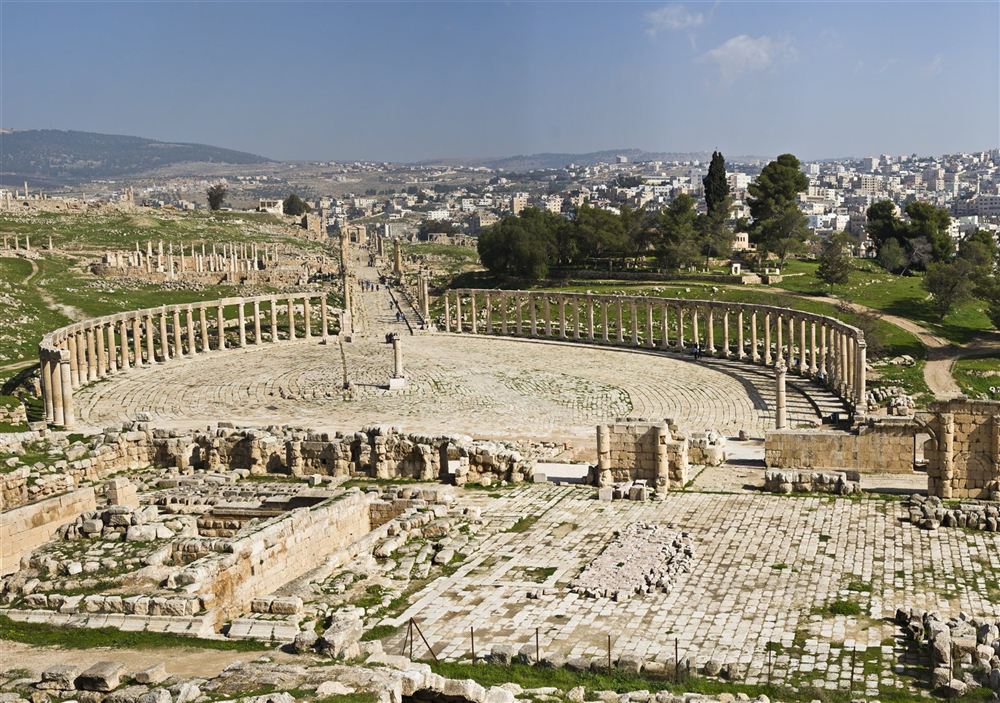
The Oval Plaza. Pass through the south gate and the city opens dramatically into its most famous space: a vast oval forum, paved in stone and ringed by a colonnade of standing columns. It is an unusual, almost theatrical shape, and it is the image most people carry away from Jerash — the sweep of columns against the sky.
The Cardo Maximus. From the plaza the great colonnaded main street runs the length of the city. This is the heart of the visit: a paved avenue lined on both sides by columns, with the drainage channels, shopfronts and public fountains of a working town still in place. Look down at the paving and you can find the grooves worn by centuries of chariot and cart wheels — the most quietly astonishing detail on the whole site.
The temples of Artemis and Zeus. Rising above the street are the city's two great sanctuaries. The Temple of Artemis, dedicated to the patron goddess of Gerasa, still lifts a row of enormous columns against the hillside; the Temple of Zeus stands nearby, above the plaza, with commanding views back over the oval forum. Together they show how completely religion, commerce and public life shared the same few hundred metres.
The South and North Theatres. Gerasa had two theatres, and both survive well. The larger South Theatre is famous for its acoustics — stand on the marked spot at its centre and your voice carries to the top rows — and you will often find Jordanian bagpipers, a legacy of the country's military tradition, playing to the stone seats. The smaller North Theatre is quieter and more intimate. Climb to the upper rows of either for the best overall view across the ruins.
The Nymphaeum. Along the Cardo, don't miss the Nymphaeum, the city's ornamental public fountain. Once faced with marble and topped with carved half-domes, it fed water into a basin for the whole street — a reminder that a Roman city was as much about engineering and daily comfort as about temples and theatres.
Combine it with Ajloun and the north
Jerash alone is a half day. To make it a full and satisfying day trip, pair it with the green hills to the west — the part of Jordan few first-time visitors expect. The classic combination is Jerash in the morning and Ajloun Castle in the afternoon.
Ajloun Castle — properly Qal'at ar-Rabad — is a 12th-century Ayyubid fortress built in the era of Saladin to guard the region and watch the routes below. It is a complete contrast to Jerash: not a Roman city of open plazas but a compact hilltop stronghold of vaulted halls, arrow slits and spiral stairs, perched high enough that on a clear day the view runs for miles across the Jordan Valley. The drive from Jerash takes about 45 minutes through pine forest and olive terraces — the greenest, coolest corner of the country.
If you have more time or a keen interest in nature, the Ajloun Forest Reserve nearby protects some of Jordan's last natural woodland and makes a gentle add-on. But for most day-trippers, the tidy pairing is enough: an ancient Roman city and a medieval Arab castle, joined by an hour of hill roads, all within easy reach of Amman. It is one of the best ways to see that Jordan is not only desert and Petra — the north is a different country of green ridges and cool air.
Practical tips: timing, tickets and guides
Go in the morning. Jerash is a large open site with very little shade, and the midday sun in summer is fierce. Arrive early — soon after opening — to walk the main axis in comfort and to see the ruins before the coach groups arrive. The light is also softer and better for photographs early and late in the day.
Tickets and the Jordan Pass. Jerash is one of the sites covered by the Jordan Pass, which bundles your entry visa with Petra and around forty other attractions. If you are already buying the pass, entry here costs you nothing extra and you skip the ticket queue. If not, you simply pay at the gate.
Allow enough time. Two to three hours is the minimum to do the site justice; a half to full day is ideal, especially combined with Ajloun. Don't try to rush the Cardo — the details reward a slow walk.
Consider a guide. Jerash is impressive on its own, but it comes alive with someone to explain what you are looking at. Licensed guides wait near the entrance, or you can book a tour from Amman that includes one. For a first visit, it is money well spent.
The Jerash Festival. If you visit in summer, check whether the Jerash Festival of Culture and Arts is on — usually a couple of weeks in July. The ancient theatres and plazas host music, dance and poetry, and there is something unforgettable about a Roman theatre doing exactly what it was built for. See our guide to the best time to visit Jordan to plan around it.
What to bring. Sun hat, water, and proper shoes — the paving is uneven and you will be on your feet for hours. There is little food inside the site, so eat before or plan lunch in Jerash town or up in Ajloun.
Frequently asked questions
How far is Jerash from Amman?
Jerash sits about 50 km north of Amman, and the drive takes roughly 50 minutes on the main highway. That makes it one of the easiest big sights to reach from the capital — closer than the Dead Sea and far closer than Petra. A taxi, a hired car with driver, or a guided tour all get you there before the morning heat.
How long do you need at Jerash?
Allow two to three hours as an absolute minimum to walk the main axis from Hadrian's Arch to the temples and theatres. Most people are happy with a half day; anyone who loves ruins can easily fill a full day, especially if a guide brings the site to life. Combined with Ajloun Castle, Jerash becomes a comfortable full-day trip from Amman.
Is Jerash included in the Jordan Pass?
Yes. Jerash is one of the many sites covered by the Jordan Pass, which bundles your tourist visa with entry to Petra and around 40 other attractions. If you are already buying the pass for Petra, entry to Jerash is effectively free, so there is no separate ticket to worry about at the gate.
Can you combine Jerash and Ajloun in one day?
Yes, and it is the classic northern day trip. Ajloun Castle — Qal'at ar-Rabad, a 12th-century Ayyubid fortress from Saladin's era — is about a 45-minute drive from Jerash through green pine hills. Do Jerash in the cooler morning, then drive up to Ajloun for the castle and the views in the afternoon.
When is the Jerash Festival?
The Jerash Festival of Culture and Arts takes place in summer, usually across a couple of weeks in July. The ancient theatres and plazas become stages for music, dance and poetry from Jordan and beyond. If you visit during the festival, expect livelier crowds in the evenings and a rare chance to see a Roman theatre used for what it was built to do.