Jordan's Christian & holy sites: Bethany, Mount Nebo & Madaba
Long before it was a country on a map, this was the land of the Book. The Jordan River where Jesus was baptised, the hill where Moses saw the Promised Land, the oldest map of the Holy Land laid out in coloured stone — all of them sit within an easy morning of Amman, on the edge of the great rift where the land drops toward the Dead Sea. Jordan has quietly kept these places for two thousand years, and it keeps them still: honoured, open to pilgrims of every faith, and refreshingly unhurried. Here is what the holy sites are, why they matter, and how to see the essential three in a single unforgettable day.
Heads up: some links on this page are affiliate links. If you book through one we may earn a small commission at no extra cost to you — it keeps these guides free. It never changes what we recommend.
A land of the Book
Jordan holds one of the densest clusters of biblical geography anywhere. The reason is the land itself: the deep valley of the Jordan River runs like a seam down the country's western edge, and along it lie the places where scripture and history meet. For pilgrims this is holy ground; for everyone else it is a living museum of the ancient Near East, with Byzantine churches and mosaics that have survived, in the open air, for fifteen centuries.
Three sites form the heart of any visit — Bethany, Mount Nebo and Madaba — and they sit so close together that you can see all three between breakfast and sunset. Two more, Machaerus and Umm ar-Rasas, reward anyone with a little extra time. Throughout, one thing sets the Jordanian experience apart: a long, lived-in tradition of religious coexistence, where a Christian mosaic town and a great mosque share the same quiet hills.
Bethany-beyond-the-Jordan: the Baptism Site
Begin where Christianity itself begins. Bethany-beyond-the-Jordan, known in Arabic as Al-Maghtas, sits on the east bank of the Jordan River just north of the Dead Sea. It is widely identified as the place where Jesus was baptised by John the Baptist, and in 2015 it was inscribed as a UNESCO World Heritage Site — recognition of both its spiritual weight and its remarkable archaeology.
What you actually walk through is a green ribbon of springs and reeds threaded with the remains of the early church. A short path leads past ancient baptism pools and the stone foundations of Byzantine churches and chapels, built and rebuilt by pilgrims over the centuries, down to the river itself. The Jordan here is narrow and slow, and the far bank is another country — so the site sits right against the border, which is why it is almost always visited on a short guided walk rather than wandered alone.
It is a working pilgrimage site as much as an archaeological one. Modern churches of several denominations cluster nearby, and on holy days the riverbank fills with the faithful. Come early for the cool and the quiet; the walk is exposed, so bring water and a hat.
Mount Nebo: where Moses looked out
A short drive up out of the valley brings you to Mount Nebo, and one of the most resonant views in the region. This is the hill where, according to the Bible, Moses stood at the end of the long journey from Egypt and looked out over the Promised Land he would never enter. Stand at the western edge on a clear day and you understand the story instantly: the Jordan Valley falls away below, the Dead Sea glints to the south, Jericho sits across the haze, and Jerusalem lies somewhere on the far ridge.
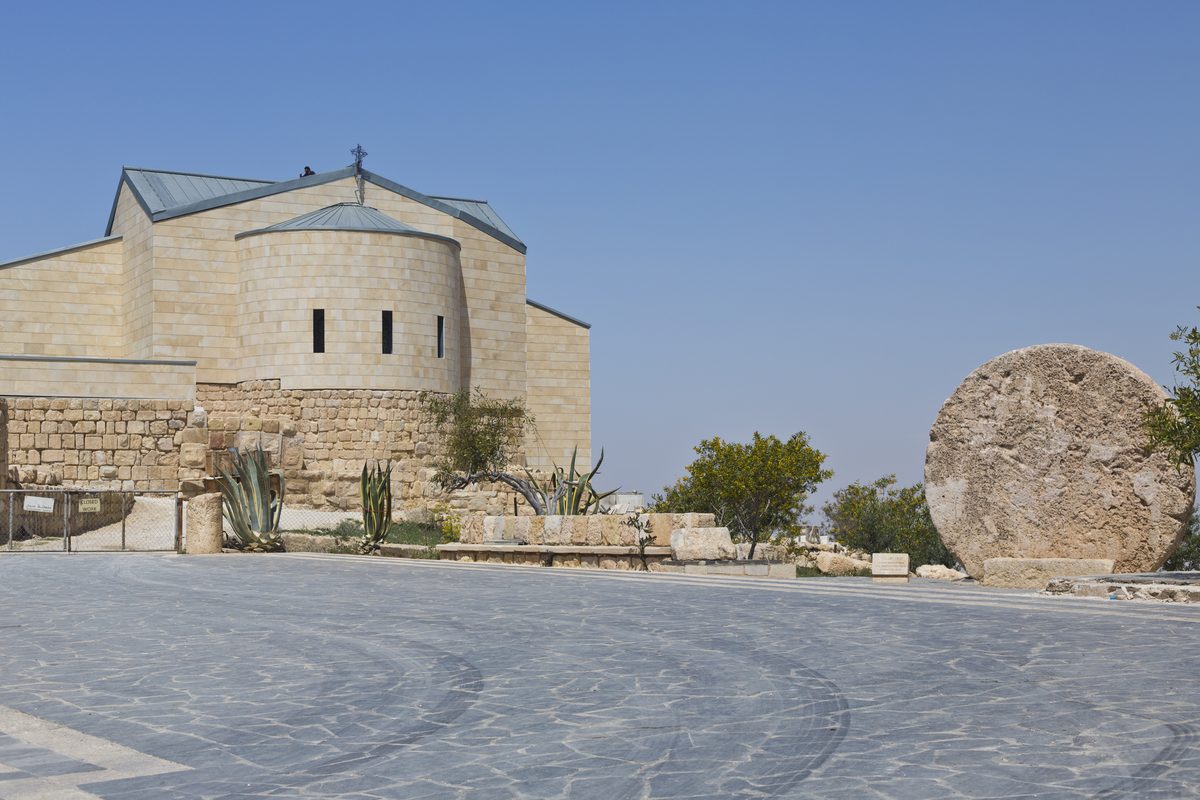
At the summit stands the Moses Memorial Church, a modern shelter built over an early Christian sanctuary. Inside, it preserves some of the finest Byzantine floor mosaics in Jordan — a famous hunting-and-herding panel alive with animals, laid down in the 6th century and astonishingly intact. Outside, the abstract Brazen Serpent monument, a cross entwined with a serpent, recalls the bronze snake Moses is said to have raised in the wilderness.
Nebo is compact and easy — a short, gentle walk from the car park — which makes it a natural centrepiece of the holy-sites loop. Allow time simply to stand at the viewpoint; it is the kind of place people fall silent.
Madaba & the mosaic map
Ten minutes downhill from Nebo lies Madaba, the friendly market town known across the world as the City of Mosaics. Its treasure sits on the floor of the modest Greek Orthodox Church of St George: the Madaba Map, a 6th-century mosaic that is the oldest surviving map of the Holy Land. Picked out in hundreds of thousands of coloured stones, it charts the region from the Nile to Lebanon, with a detailed, walled Jerusalem at its centre — a work that is part sacred art, part ancient cartography, and endlessly studied by scholars.
Madaba wears its mosaic heritage lightly and everywhere. Beyond St George's, the town has more Byzantine floors under its churches and in its archaeological park, and — best of all — living mosaic workshops where craftspeople still cut and set stone by hand, keeping a fifteen-hundred-year-old skill alive. It is also simply a pleasant place to pause: a compact old centre, easy cafés, and a strong Christian community that gives the town its particular warmth.
Because it is walkable and welcoming, Madaba makes an ideal base or lunch stop on the loop — many travellers even prefer to sleep here rather than in Amman, using it as a quiet gateway to the sites and the Dead Sea.
Beyond the big three: Machaerus & Umm ar-Rasas
If you have more than a day, two further sites deepen the story and see almost no crowds.
- Machaerus (Mukawir). South of Madaba, a lone conical hill rises above the gorges near the Dead Sea. On top stand the ruins of Herod's fortified palace — the Machaerus of the Gospels, traditionally the place where John the Baptist was imprisoned and beheaded. The reward is the climb and the setting: a windswept hilltop with re-erected columns and a vast, silent view over the rift. Go for the atmosphere and the sunset light as much as the history.
- Umm ar-Rasas. Further south again, this UNESCO World Heritage Site preserves the remains of a fortified Roman and Byzantine town. Its glory is a group of church mosaics — above all the great floor of St Stephen's, a panel that pictures the cities of the Holy Land and the Nile in astonishing detail, sheltered today under a protective roof. Two tall stone towers nearby, one a rare stylite's pillar, add to the strange grandeur of the place.
Together with the big three, these sites trace Jordan's role on the wider Christian pilgrimage route — and stand as evidence of the country's long, unbroken tradition of religious coexistence.
How to visit: the day loop, dress & guides
The classic loop. Madaba, Mount Nebo and Bethany sit within a small triangle west of Amman and make a comfortable single day. A common rhythm is Bethany first thing (for the cool), Mount Nebo late morning, and Madaba for lunch and the map — or the reverse. Because all three lie on the way down to the Dead Sea, many people finish with an afternoon float; the sites also sit naturally on a King's Highway drive south toward Petra.
Dress modestly. These are active places of worship. Cover shoulders and knees at churches and religious sites, and carry a light scarf; wear comfortable shoes for the hilltops at Nebo and Machaerus, and bring sun protection for the open path at Bethany.
Guides. Bethany is normally seen on a short guided walk because of its riverside, border-adjacent setting, and a guide adds a great deal at Nebo and Madaba too — the mosaics come alive with someone to read them. Whether you join a tour from Amman or Madaba or hire a driver for the day, the loop is one of the easiest and most rewarding in Jordan.
Frequently asked questions
Where was Jesus baptised in Jordan?
The site is Bethany-beyond-the-Jordan, known in Arabic as Al-Maghtas, on the east bank of the Jordan River north of the Dead Sea. This UNESCO World Heritage Site is widely identified as the place where Jesus was baptised by John the Baptist, and its baptism pools, springs and early churches have drawn pilgrims for centuries.
What can you see at Mount Nebo?
Mount Nebo is the hill where, according to the Bible, Moses looked out over the Promised Land. Today you can see the Moses Memorial Church, which shelters remarkable Byzantine floor mosaics, and the modern Brazen Serpent monument outside it. From the terrace the view sweeps across the Jordan Valley and the Dead Sea toward Jericho, and on a clear day toward Jerusalem.
What is the Madaba Map?
The Madaba Map is a 6th-century mosaic on the floor of St George's Church in Madaba. It is the oldest surviving map of the Holy Land, laid out in coloured stone, and it famously shows Jerusalem and the Jordan River. Madaba is known as the City of Mosaics, and living workshops in town still teach the craft today.
Can you visit Madaba, Mount Nebo and Bethany in one day?
Yes. Madaba, Mount Nebo and Bethany-beyond-the-Jordan sit close together and form a classic day loop from Amman, easily done in a single day. Because they lie on the way down to the Dead Sea, many travellers combine the three holy sites with an afternoon float, or fold them into a King's Highway drive south.
What should you wear at Jordan's holy sites?
Dress modestly. Cover your shoulders and knees at churches and religious sites, and keep a light scarf handy for the shoulders. Comfortable shoes help at hilltop sites like Mount Nebo and Machaerus, and a hat and water are wise for the exposed, sunny paths at Bethany.